I didn’t know grief could arrive in so many disguises.
It first came as loss – the babies I never held, whose tiny heartbeats I once prayed over, and whose absence still echoes in my body. Miscarriages that came like storms, sudden and brutal, leaving me bleeding not just physically, but in my soul. Then came the loss of the marriage I couldn’t save, the dream of a family I thought would remain whole.
It came as an absence of two long years without my children during lockdown, their laughter trapped in old videos, while my arms stayed empty. And it came as silence – the kind after betrayal, when words feel dangerous, and you learn to breathe without making a sound, because even that hurts.
For a long time, I thought healing meant getting over it, that one day I would wake unmarked by pain and return to the woman I was before. But grief doesn’t work like that. It doesn’t erase you. It remakes you, cell by cell, belief by belief.
Somewhere between sobbing on the bathroom floor and showing up for another day, joy started sneaking in: my daughter’s laughter while dancing in the kitchen, the warmth of a friend’s hand that said, “I see you”, the quiet promise of a sunrise after a night I thought would never end.
I stopped asking, “When will this end?” and started asking, “What is this teaching me?”
Grief taught me that I am not my losses, that I can hold sorrow in one hand and gratitude in the other, and that letting go is not abandonment – it is trust.
It taught me to rebuild differently, to stop pretending I was “fine” and instead speak the truth of my pain, to create spaces where women could bring their whole selves without shame or masks. That’s how one of my signature retreats, Still Reset, was born. They were not just events; they were lifeboats, carrying women who thought they were drowning back to shore.
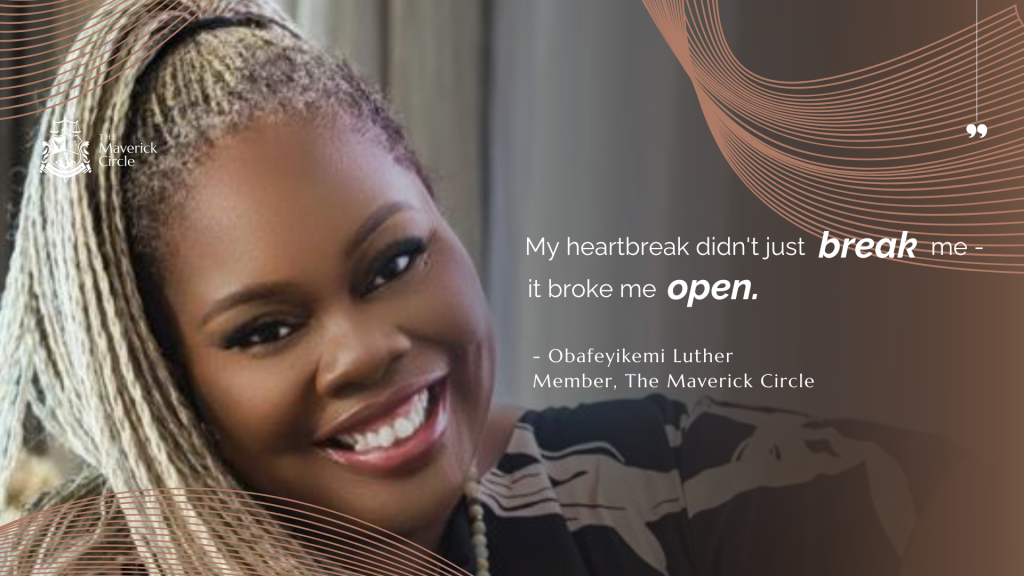
My heartbreak didn’t just break me – it broke me open.
If you are reading this in the thick of loss, please hear me: you don’t have to rush to be “okay.” Healing has its own rhythm. You may laugh on Monday and cry on Tuesday. You may hold your child and still ache for the ones you never met. You may feel joy and grief in the same breath. This is not weakness. This is being human.
One day, you will look back and see that the version of you who crawled through the valley of heartbreak is the same one who now stands in the sunlight, stronger, softer, wiser.
When we heal together, we grow together. And sometimes, grief is the very thing that plants the seed.
Princess Ọbáfèyìkémi Dędęnúolá Luther
Member, The Maverick Circle


